
Why NestJS?
When it comes to building complex backends with Node.js, the biggest challenge isn't performance—it's architecture. Express is great for small projects, but it lacks a structured approach, leading to "spaghetti code" as the project grows. NestJS solves this by providing a highly opinionated, modular framework built on top of TypeScript.
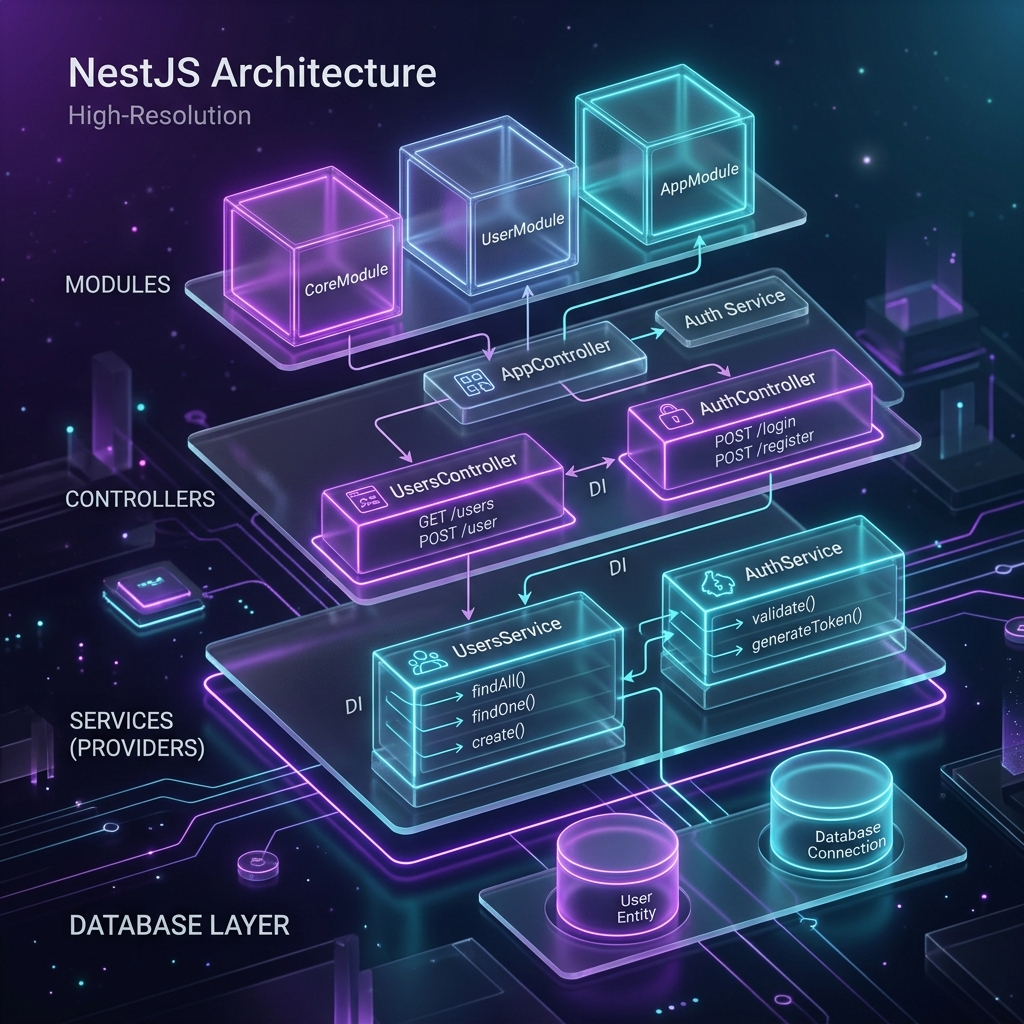
The Modular Architecture
The core of NestJS is the Module. Everything—controllers, services, gateways—is organized into modules. This makes it incredibly easy to share code between projects or transition to a microservices architecture later.
@Module({
  imports: [UsersModule, AuthModule],
  controllers: [AppController],
  providers: [AppService],
})
export class AppModule {}
Dependency Injection and Testing
NestJS uses a powerful Dependency Injection (DI) system, which is rare in the JavaScript ecosystem. This makes your code more decoupled and vastly easier to test. Instead of importing services directly, you "inject" them through the constructor.
@Injectable()
export class UsersService {
  constructor(private prisma: PrismaService) {}

  async findOne(id: string) {
    return this.prisma.user.findUnique({ where: { id } });
  }
}
Interceptors and Decorators: The Power of Aspect-Oriented Programming
NestJS allows you to use Interceptors to intercept requests and responses, and custom Decorators to clean up your controller logic. For example, you can create a @CurrentUser() decorator to automatically extract the authenticated user from the request.
Real-time with WebSockets
NestJS has first-class support for WebSockets (via Socket.io or ws). You can build real-time features like chat, notifications, or live dashboards with minimal boilerplate.
Performance Optimization Tips
- Use Fastify: While NestJS uses Express by default, you can easily switch to Fastify for up to 2x better performance.
- Prisma/Drizzle for Type-safe DB Access: Avoid heavy ORMs like TypeORM if performance is critical.
- Redis for Caching: Implement caching at the interceptor level to reduce DB load.
Conclusion
NestJS isn't just a framework; it's a platform that encourages good software engineering practices. While the learning curve is steeper than Express, the long-term benefits in terms of maintainability and scalability are well worth the effort.